Miyhela: A Refined Script Font for Handmade Labels & Printables
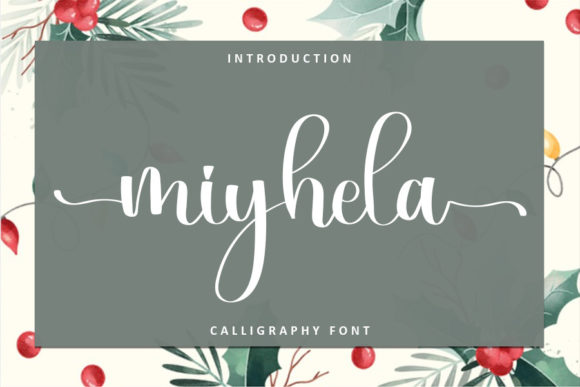
There’s that quiet, focused moment—early morning light, coffee steaming beside my laptop—when I’m designing candle labels for a new lavender-vanilla batch. I scroll past dozens of script fonts, but something feels off: too fussy, too fragile, or worse—too generic. Then I open Miyhela. Instantly, the lowercase “g” with its gentle loop and the elegant upward flick of the capital “M” tell me this isn’t just another decorative typeface. It’s a refined script font with warmth, rhythm, and quiet confidence—exactly what handmade goods need to feel intentional, not incidental.
Miyhela lives in the sweet spot between classic elegance and modern simplicity. It’s not overly ornate like Victorian scripts, nor is it so minimalist it loses personality. The strokes have subtle contrast—slightly thicker downstrokes, graceful thins—giving it presence without stiffness. Letters connect smoothly but never crowd one another, making it highly legible even at small sizes. That balance is why it shines across so many maker applications: from delicate foil-stamped wedding invitations to crisp black-and-white printable planner pages, from rustic farmhouse signs to clean SVG cut files for Cricut users.
I’ve used Miyhela on actual product labels—small 2” x 3” kraft paper tags for soy candles—and it held up beautifully. The letterforms retain their character even when scaled down to 14pt, especially with solid ink coverage. For sticker sheets, I tested it on matte vinyl at 10mm height: still readable, still charming. On digital printables—like birthday party templates or printable wall art—it adds instant sophistication without needing extra design flourishes. And because it’s part of the Script Amp collection, it’s built with real-world production in mind: clean vector outlines, consistent spacing, and smooth curves that cut cleanly on Silhouette Cameo and Cricut machines.
What makes Miyhela especially useful for makers is how thoughtfully it handles context. It’s a display font first—ideal for names, titles, short phrases, and decorative wording—but not meant for long paragraphs. That’s perfectly fine. In our world, we rarely need full-body text in script: it’s the brand name on a tote bag, the “Hand-poured” line on a candle jar, the “Thank You” on a boutique thank-you card. Those moments matter most—and Miyhela delivers emotional resonance in just a few letters.
For pairing, I almost always reach for a clean sans serif—think Montserrat Light or Poppins Regular—as a grounded counterpoint. When designing a holiday gift tag, I set the recipient’s name in Miyhela, then use the sans for “From: [Name]” and the date below. Same goes for wedding stationery: Miyhela for the couple’s names and ceremony title, a soft serif like Lora for body text. The contrast creates visual hierarchy and keeps things approachable—not precious.
Real-world testing taught me a few practical notes. First: Miyhela includes stylistic alternates and swashes—use them sparingly. That elegant capital “A” with the extended flourish? Perfect as a standalone monogram on a mug or tote, but avoid stacking multiple swash-heavy letters in a row on small labels—they can blur together. Second: always preview your text at actual output size. What looks lovely at 72pt on screen may tighten unpredictably at 8pt on a 1.5” product tag. Third: check file formats. Miyhela comes in OTF and TTF, both widely supported, and includes multilingual glyphs—handy if you offer bilingual greeting cards or ship internationally.
Licensing is non-negotiable when you’re selling physical products or digital downloads. Miyhela is a commercial font, meaning it’s cleared for use in merchandise, packaging, and printable templates—as long as you follow the license terms. No hidden restrictions for Etsy sellers or Canva designers. That peace of mind matters when you’re bundling planner pages or prepping SVG files for crafters.
Seasonal work is where Miyhela really flexes. For spring collections, I used it on pastel-hued greeting cards—“Hello, Spring!” in soft sage ink—with delicate line art botanicals. In autumn, it anchored a set of printable harvest-themed wall art: “Gather Joy” in warm terracotta, paired with a simple serif subtitle. Even on ceramic mugs (printed via sublimation), the font’s balanced weight prevented thin strokes from fading or thick ones from bleeding.
It also elevates everyday shop assets. My “New Arrivals” banner on Instagram? Miyhela. The “Handmade with Care” tagline on packaging tape? Miyhela. The header font in my digital template previews? Always Miyhela. Consistency builds recognition—not flashy logos, but the quiet familiarity of a trusted typeface that says, “This was made with attention.”
Of course, no font solves everything. If your label needs ultra-tight spacing for limited real estate, or if your audience skews toward bold, high-contrast branding, Miyhela might sit softer than you’d like. But for makers who value craftsmanship, clarity, and quiet charm—those of us who stitch, pour, press, print, and package by hand—it’s more than a font. It’s a design partner that understands the weight of a handwritten note, the hush before a wedding vow, the pride in a perfectly labeled jar.
So next time you’re choosing type for your next batch of greeting cards, seasonal stickers, or boutique packaging—pause before defaulting to the familiar. Open Miyhela. Try “Small Batch” in all caps. Type “Made with Love” in sentence case. See how the letters breathe, how they invite touch, how they hold space without shouting. That’s the difference a thoughtful script font makes—not just in pixels or ink, but in how your handmade work is felt.